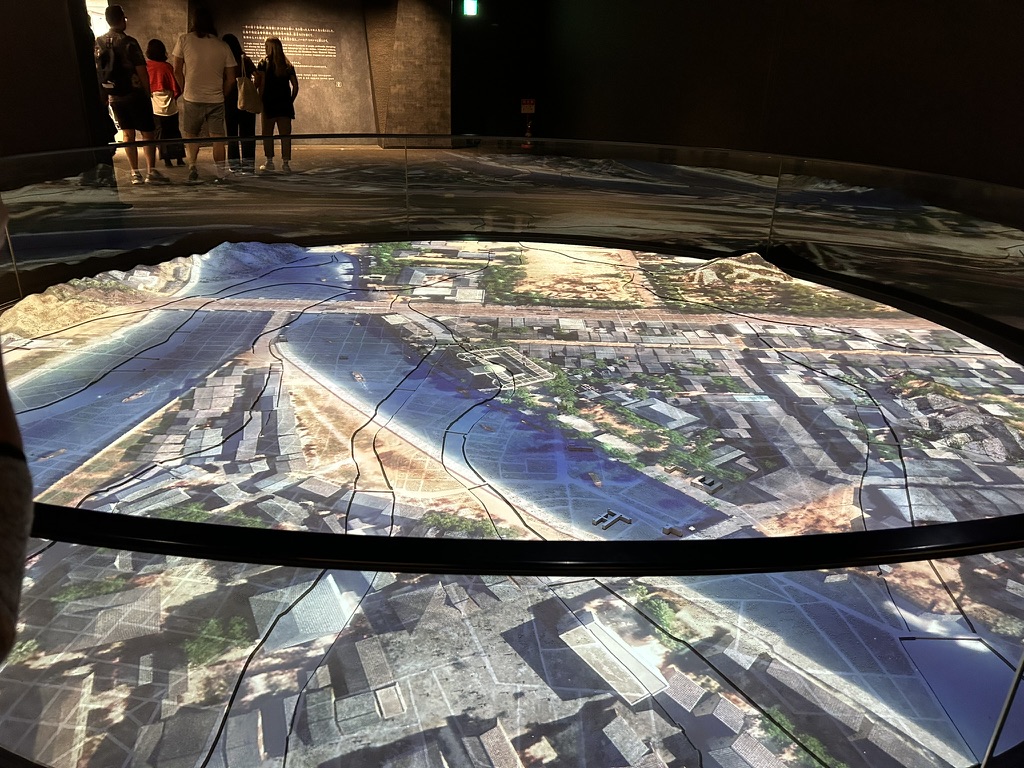
The first thing you see, after the entrance and up the stairs, is a room. The walls are covered in photographs — wall-size, nearly 360 degrees of them. You stop walking without deciding to.
They show Hiroshima after the bomb. Not before. After. An open field where a city used to be.
The room is usually quiet. People go quiet in it without being asked.
Before you go in
I go about once a year — not because I plan to, it simply happens. The last time was February 2026. I usually end up going on weekends, which means it is crowded. It is usually crowded regardless — most visitors to Hiroshima come here, and they come from everywhere.
If you can go in the morning, do. The museum opens at 8:30am and the first hour is calmer. Tour groups tend to arrive between 10am and noon, and when they do, the rooms fill. Going early means you can stop when you need to, without anyone pressing behind you.
I usually spend close to two hours. It never quite feels like enough.
If you arrive early, walk through Peace Memorial Park first, from the A-Bomb Dome end. Let the morning settle before you go inside.
What you will find inside
The permanent exhibition walks you through the morning of 6 August 1945. The science is explained. The scale is documented. Maps, photographs, reconstructions of the city before and after.
That is not what stays with me.
What stays with me are the letters. Handwritten, in Japanese. One man writes about his worry for his family's finances after he is gone — not about the bomb, not about history, just whether they will be all right. Others describe ordinary farewells — a family member seen off in the morning the way you would any other day, not knowing it was the last time.
Reading them in the original Japanese, in someone's actual handwriting, with the tone they chose — careful, hurried, tender, afraid — is something else entirely.
The first time I came here I was somewhere between ten and twelve years old.
At that time there was a wax figure — human figures amid the destruction, lifelike and terrifying in the way childhood impressions can be. The impact stayed with me for years. That figure was removed in 2017 before the major renovation. I think it is a shame it is gone.
After
When you come out, you are back in the park. I always sit somewhere — there are benches all over Peace Memorial Park — and I stay for a while.
You watch people. Some are at the Cenotaph, praying or standing quietly. Others are taking photographs. A tram goes past on the other side of the river. Someone cycles over the bridge. The city continues, completely ordinarily.
There is something about that ordinariness after what you have just seen. The gap between the two is not easy to describe. In Japanese there is a word — 有難い (arigatai) — that comes closer than "grateful" does. Literally it means something like "difficult to exist," "rare to be." It is the root of arigatou.
What I keep coming back to is this: the only thing that separates me from the people in those letters is when and where I was born. That is all.
When I am ready to move again, I walk back into the city. The trams are running. There are restaurants, people, the river in the afternoon light. Hiroshima is not a city defined by what happened to it — it is a city that rebuilt itself, and that is what you are walking through. I find that, after the museum, I notice it more.
I go back about once a year — not out of obligation. It just happens. Each time, I come out and sit somewhere in the park. It is not a sad feeling, exactly. It is closer to 有難い.
Practical information
Hours — Daily 8:30am–6:00pm · Until 7:00pm July–August · Until 8:00pm on 6 August · Closed 30 December–1 January
Entry — Adults ¥200 · High school students ¥100 · Junior high and below: free
Getting there — Tram lines 2 or 6 to Genbaku Dome-mae stop, or tram line 1 to Fukuro-machi. The museum is at the south end of Peace Memorial Park.
Audio guide — Available in multiple languages at a small additional fee.
Website — hpmmuseum.jp ↗
Planning your time in the city? Two days in Hiroshima →